
The Enterprise Guide to AI Agents: Transforming Business Operations Beyond Chatbots
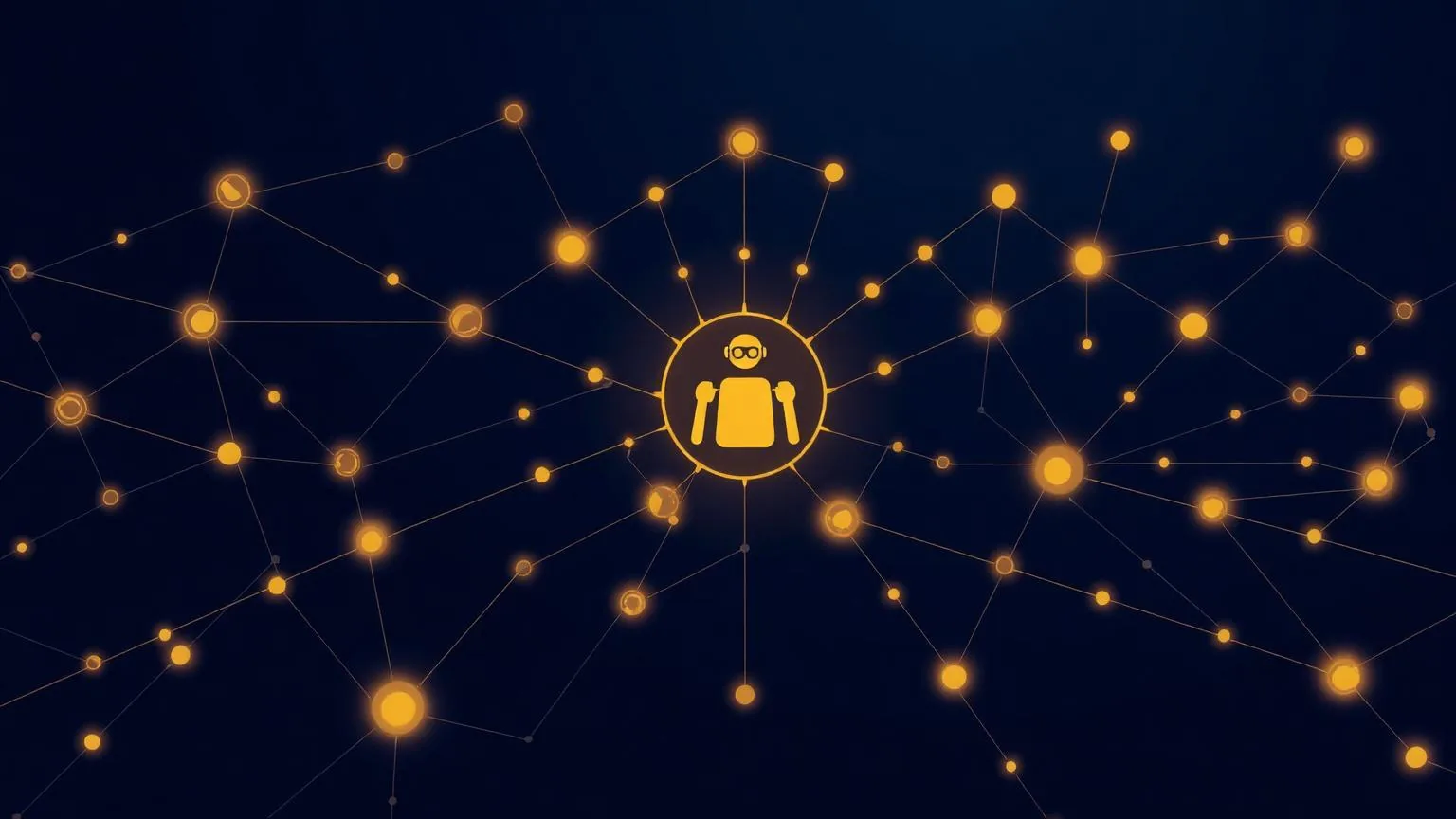
AI agents are not smarter chatbots. They plan, act, and coordinate — and the enterprises deploying them well are compounding a real operating advantage.
A chatbot answers a question. An agent takes an objective, decomposes it into steps, calls the tools it needs, checks its work, and comes back with a result. That distinction sounds academic until you watch one clear a backlog of 400 invoice exceptions overnight, or reconcile a week of broker submissions in two hours.
Enterprises that treated 2024 as 'the chatbot year' are now hitting the ceiling of that pattern. The next order-of-magnitude gain is agentic — and the architecture, governance, and change-management implications are meaningfully different. This guide walks through what enterprise-grade AI agents actually are, where they belong, and how to ship them without creating a new class of production incident.
What an AI agent actually is
Strip the marketing and an AI agent is four things wired together: a language model that plans, a set of tools it can call, a memory that persists between steps, and a loop that lets it decide what to do next based on the result of the previous step. Anthropic's 'Building effective agents' guide (2025) frames this well — the interesting behavior emerges from the loop, not the model.
In enterprise contexts, the useful mental model is 'a very fast junior analyst with API access.' They can execute a bounded workflow, they will occasionally take a wrong turn, and they need supervision, guardrails, and a clear escalation path. Treat them exactly like a new hire in month one and you'll ship them well.
Where agents belong in the enterprise stack
Not every workflow deserves an agent. Deterministic pipelines with a clear happy path are better served by traditional orchestration (Airflow, Temporal, n8n). Agents earn their keep in workflows with three characteristics: variable inputs, multiple valid paths to the outcome, and tolerable rework cost when the agent takes the wrong branch.
Workflows where agents shine
- Claim intake and triage — variable formats, clear rubric, 2–5 branches.
- Vendor and contract review — long documents, structured extraction, exception flagging.
- Sales research and account planning — many sources, judgment on relevance.
- Tier-1/2 IT and HR support — bounded intents, tool calls, escalation on ambiguity.
- Data reconciliation across systems — messy joins, human-readable exceptions.
Workflows where agents don't
- Pricing, credit, or medical decisions where the audit path must be deterministic.
- Sub-100ms latency paths (agents typically add 2–15s per loop).
- Anything where the cost of the wrong action exceeds the cost of building the deterministic version.
The three architecture patterns that hold up in production
Across the agent programs we've reviewed, three patterns account for roughly 90% of the systems that made it to production.
1. Router + specialists
A lightweight router agent classifies incoming work and dispatches to one of several narrow specialist agents. Each specialist has a small toolset, a tight system prompt, and its own eval set. This pattern is the workhorse for support, claims, and back-office ops.
2. Plan-then-execute
A planner produces an ordered task list, an executor runs the tasks with tool access, and a reviewer checks the output against the original objective before returning. This pattern fits research, reconciliation, and reporting workflows well and is the shape used by most enterprise deployments of LangGraph and Microsoft AutoGen.
3. Human-in-the-loop supervisor
Free 30-min audit
Want us to build this for your business?
We build complete AI systems for sales, support, operations, and back-office work. Book a free 30-minute assessment — we'll map the highest-value process and what an end-to-end system could look like.
Book a free callFor high-stakes work, an agent drafts the action and a human approves or edits before execution. This is where regulated industries live — the agent still delivers throughput, but every material action has a signed-off human on record. The EU AI Act's Article 14 essentially mandates this pattern for high-risk systems.
What breaks in production
Agents fail differently than chatbots. Three categories dominate incident post-mortems.
- Tool-call loops: the agent calls the same tool 30 times because the response format changed. Fix with retry limits and tool-schema validation.
- Silent policy violations: the agent completes the task by taking a path nobody sanctioned. Fix with pre-execution allow-lists and a deny-list of destructive tools.
- Cost blowouts: one bad prompt puts a plan-then-execute loop into a $4,000 overnight run. Fix with per-run token budgets, hard timeouts, and cost alerting.
Every production agent needs a hard token budget, a maximum step count, and an allow-list of tools. Skip any of the three and you will pay for the lesson.
Governance and evaluation for agents
Chatbot evals measure single-turn quality. Agent evals have to measure trajectories: did the agent take a reasonable path, use the right tools in a reasonable order, and land within budget on the correct outcome? OpenAI's Evals framework and Anthropic's evaluation cookbook both support trajectory-level metrics, and the LangSmith and Langfuse platforms bake this in for teams that don't want to build it.
At minimum, every production agent should ship with: a golden dataset of 100+ trajectories, per-step and end-to-end success metrics, a regression harness that runs on every prompt or tool change, and dashboards for cost, latency, and escalation rate. This is not optional — it's the difference between an agent you can operate and an agent that quietly degrades.
How to sequence an agent program
The pattern that keeps working: pick one bounded workflow with a clear P&L owner, ship a Router + specialists pattern with human-in-the-loop for the first 60 days, remove the human from steps where escalation rate stays under 5%, and only then start a second workflow. Programs that try to launch three agent workflows simultaneously in month one land in change-management debt they never dig out of.
Tutorial: a Router + specialists agent in ~90 lines of Python
The simplest production pattern is a router that classifies incoming work and hands it to a bounded specialist. Below is a minimal LangGraph implementation with hard guardrails — token budget, step cap, tool allow-list — that we use as a starter scaffold for enterprise support and claims agents.
# agent_router.py — Router + specialists with hard guardrails
from typing import TypedDict, Literal
from langgraph.graph import StateGraph, END
from langchain_openai import ChatOpenAI
from langchain_core.tools import tool

MAX_STEPS = 8
MAX_TOKENS = 20000
ALLOWED_TOOLS = {"lookup_customer", "fetch_policy", "escalate"}

class S(TypedDict):
    query: str
    lane: Literal["billing", "claims", "other"]
    steps: int
    tokens: int
    result: str

llm = ChatOpenAI(model="gpt-5.1-mini", temperature=0)

@tool
def lookup_customer(customer_id: str) -> dict:
    """Return customer profile by ID."""
    return {"id": customer_id, "tier": "gold", "region": "US"}

@tool
def fetch_policy(policy_id: str) -> dict:
    """Return policy terms by ID."""
    return {"id": policy_id, "deductible": 500, "coverage": "auto"}

@tool
def escalate(reason: str) -> str:
    """Escalate to a human queue with a reason."""
    return f"escalated: {reason}"

def route(state: S) -> S:
    prompt = f"Classify into billing | claims | other: {state['query']}"
    lane = llm.invoke(prompt).content.strip().lower()
    return {**state, "lane": lane if lane in {"billing", "claims"} else "other"}

def billing_specialist(state: S) -> S:
    if state["steps"] >= MAX_STEPS or state["tokens"] >= MAX_TOKENS:
        return {**state, "result": escalate.invoke({"reason": "budget exhausted"})}
    return {**state, "steps": state["steps"] + 1, "result": "billing handled"}

def claims_specialist(state: S) -> S:
    if state["steps"] >= MAX_STEPS or state["tokens"] >= MAX_TOKENS:
        return {**state, "result": escalate.invoke({"reason": "budget exhausted"})}
    return {**state, "steps": state["steps"] + 1, "result": "claim handled"}

def human_handoff(state: S) -> S:
    return {**state, "result": escalate.invoke({"reason": "out of scope"})}

g = StateGraph(S)
g.add_node("route", route)
g.add_node("billing", billing_specialist)
g.add_node("claims", claims_specialist)
g.add_node("other", human_handoff)
g.set_entry_point("route")
g.add_conditional_edges("route", lambda s: s["lane"], {
    "billing": "billing", "claims": "claims", "other": "other",
})
for n in ("billing", "claims", "other"):
    g.add_edge(n, END)

app = g.compile()

if __name__ == "__main__":
    out = app.invoke({"query": "Why was my premium charged twice?",
                      "lane": "other", "steps": 0, "tokens": 0, "result": ""})
    print(out)
The important lines are the guardrails, not the LangGraph plumbing: MAX_STEPS, MAX_TOKENS, and ALLOWED_TOOLS. Every one of the production incidents we've reviewed on agent systems traces back to one of these three being missing or set too generously.
How to extend this safely
- Add each new specialist as its own node with its own system prompt and eval set.
- Route destructive tools (writes, refunds, external emails) through an approval node before execution.
- Log every state transition to LangSmith or Langfuse and alert on abnormal step counts.
Frequently asked questions
What's your AI Readiness Score?
10 questions. A personalized score, profile, and a 90-day automation roadmap built for your business. No email required.

Free workflow review
Find the workflow worth automating next
Bring one process that is slow, repetitive, expensive, or leaking opportunities. We will map the current workflow, identify the bottleneck, and tell you whether automation is worth pursuing.
No obligation. If automation is not the right answer, we will say so.
0 Comments
Be the first to comment. Start the conversation below.