
An AI answering service for HVAC can answer routine inbound calls, capture job details, route emergencies, book approved appointments, update the CRM, and recover missed calls — if the workflow is designed around real dispatch rules.
An AI answering service for HVAC is a voice workflow that handles defined inbound tasks such as answering routine questions, collecting service details, identifying the location, routing urgent calls, booking approved appointment types, updating the CRM, and triggering missed-call follow-up. It should not improvise technical diagnoses, emergency guidance, or pricing rules your business has not approved.
The goal is not to make every call autonomous. The goal is to make sure every call gets the right next step.
The calls an HVAC AI receptionist can handle well
- New service enquiries
- Basic service-area questions
- Hours and routine FAQs
- Appointment requests
- Lead-detail collection
- Existing-customer status routing
- Missed-call recovery
- After-hours intake
- CRM note creation
- Escalation to an on-call person when a defined trigger is met
The calls that should escalate
- Gas, carbon monoxide, fire, or other safety-critical reports
- A caller describing a medical emergency
- Unusual technical diagnosis requests
- Pricing exceptions or disputes
- Angry or vulnerable customers
- Calls where identity, address, or job details cannot be confirmed
- Any scenario the business has not explicitly mapped
For safety-critical situations, the voice system should follow a pre-approved escalation script and route to the appropriate human or emergency instruction defined by the business. It should never invent field-service advice.
What the workflow looks like end to end
A practical flow is: answer → identify caller intent → collect address and contact details → check service area → classify routine vs urgent → offer approved booking options or transfer → write structured notes to CRM/dispatch → confirm next step by SMS or email where appropriate.
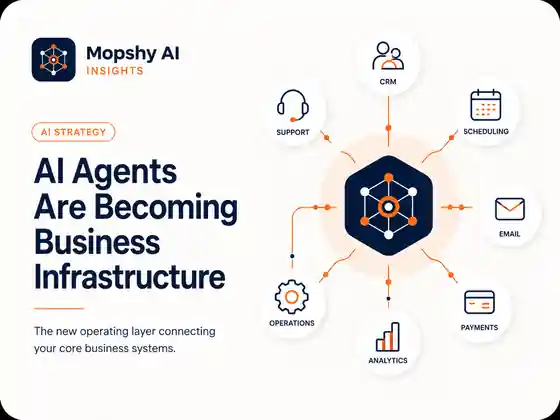
That is why the value is bigger than “AI answers the phone.” The useful system connects the phone call to dispatch, scheduling, CRM, follow-up, and reporting.
What does an HVAC AI answering service cost?
Mopshy's current public starting point for the AI Front Desk is $1,500 setup plus $497 per month. Final pricing depends on call volume, integrations, booking logic, escalation requirements, third-party telephony or AI usage, and the amount of ongoing support.
Free 30-min audit
Want us to build this for your business?
We build complete AI systems for sales, support, operations, and back-office work. Book a free 30-minute assessment — we'll map the highest-value process and what an end-to-end system could look like.
Book a free callWhen comparing providers, ask whether minutes, SMS, telephony, model/API usage, calendar integration, CRM integration, call review, tuning, and support are included, capped, or billed separately.
The integrations that matter most
- Phone or telephony provider
- Calendar or field-service scheduling system
- CRM or customer database
- Dispatch or job-management software
- SMS and email
- Reporting or call-review tools
Metrics to track
- Answer coverage
- Missed-call recovery rate
- Time to first response
- Percentage of calls resolved without transfer
- Qualified service requests
- Appointments booked and held
- Transfer reasons
- Incorrect routing or booking rate
- Revenue or jobs linked to recovered calls
A note on outbound AI voice calls
Inbound answering and outbound calling are not the same compliance problem. The FCC has stated that AI-generated voices are treated as artificial or prerecorded voices under the TCPA, so businesses should not assume AI voice creates a loophole for outbound calling. Consent and other applicable rules still matter.
If you want to map the whole lead path rather than only the phone layer, see AI automation for HVAC companies or the Pittsburgh HVAC automation page.
The short answer
An HVAC AI answering service is most valuable when it is connected to the real operating workflow: call → qualification → booking or transfer → dispatch/CRM → follow-up. It should reduce missed opportunities without pretending that every customer conversation belongs to a machine.
Frequently asked questions
What's your AI Readiness Score?
10 questions. A personalized score, profile, and a 90-day automation roadmap built for your business. No email required.

Free workflow review
Find the workflow worth automating next
Bring one process that is slow, repetitive, expensive, or leaking opportunities. We will map the current workflow, identify the bottleneck, and tell you whether automation is worth pursuing.
No obligation. If automation is not the right answer, we will say so.
0 Comments
Be the first to comment. Start the conversation below.