
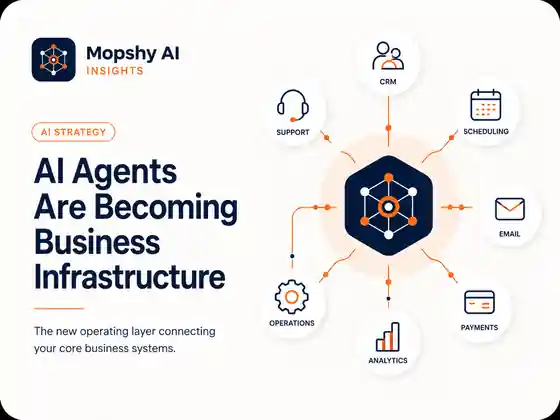
Four recent AI infrastructure moves point to the same shift: useful agents need governed access to real systems, privacy-aware routing, secure capabilities, and reliable execution.
The next competitive advantage in AI will not come only from a smarter model. It will come from connecting agents to real business systems safely, governing where data moves, securing the capabilities they use, and operating them reliably at scale.
Four developments announced on September 1 make that shift unusually clear. OpenAI pushed ChatGPT deeper into governed systems of record. Perplexity made data sensitivity part of where an agent computes. AIR launched around the security of skills, MCP servers, plugins, and other agent dependencies. Empirik focused on infrastructure that can reason about machine-speed software changes.
For a business buyer, the question is no longer just: How smart is the agent? It is: What can it access, where can the data go, what can it load, and what happens when it acts?
1. Agents Are Moving Into Systems of Record
OpenAI announced that healthcare organizations can connect authorized Epic patient context into ChatGPT for Healthcare. It also introduced a Healthcare Public Data plugin that can work with structured information from official sources including PubMed, DailyMed, ClinicalTrials.gov, and CMS data.
Healthcare is a specialized environment, but the architecture applies almost everywhere. Useful agents need governed access to the same authoritative systems employees already use: CRM, ERP, help desk, accounting, scheduling, inventory, internal knowledge, and communication tools.
A sales agent that cannot read the CRM creates duplicate work. A support agent that cannot see order history gives generic answers. An operations agent that cannot update the system of record is still mostly a chatbot. Business value appears when the agent is safely connected to the workflow itself.
Business implication: map the source of truth first. Then decide exactly what the agent may read, what it may write, and which actions require approval.
2. Privacy Is Becoming Part of Workflow Orchestration
Perplexity introduced Hybrid Compute for its Computer agent, allowing parts of a task to run on local models while other parts use frontier cloud models. Sensitive information can be kept on-device, masked, or gated by approval, and enterprise administrators can define policies for that behavior.
That points toward a broader pattern for business automation. We already route AI tasks based on quality, latency, and cost. Increasingly, companies will also route based on data classification. A workflow might inspect confidential files locally, send only permitted context to a cloud model for deeper reasoning, and then return to a controlled environment for execution.
Use AI should not mean send every piece of business data to the same model. Good automation architecture decides what information is needed for each step and applies the appropriate masking, retention, approval, and execution policy.
3. Agent Capabilities Create a New Supply-Chain Risk
Modern agents are not isolated models. They accumulate skills, MCP servers, plugins, APIs, browser tools, scripts, and external resources. AIR came out of stealth positioning itself around security and governance for that growing agent stack. TechCrunch reported that the company raised $50 million across two seed rounds.
AIR has also published research on skills that referenced abandoned, nonexistent, impersonated, or potentially hijackable dependencies. Whether or not a company uses AIR specifically, the underlying product lesson matters: every capability an agent can load becomes part of the trust boundary.
Free 30-min audit
Want us to build this for your business?
We build complete AI systems for sales, support, operations, and back-office work. Book a free 30-minute assessment — we'll map the highest-value process and what an end-to-end system could look like.
Book a free callBefore giving an agent access to email, Slack, Salesforce, QuickBooks, a browser, or production systems, define an explicit tool allowlist, least-privilege permissions, human approval points, and logging. Convenience without governance becomes operational risk very quickly.
4. Operations Must Keep Up With Machine-Speed Work
Empirik emerged from stealth with more than $21 million in funding around the idea of an autonomous infrastructure engineer. Its system models infrastructure relationships so it can evaluate proposed changes, estimate blast radius, detect drift, and surface risky changes before they reach production.
The same principle applies beyond software engineering. Once AI agents can create campaigns, update records, respond to leads, move tickets, issue follow-ups, change configurations, or trigger downstream automations, businesses need controls designed for much higher action volume.
Do not measure an automation only by how many tasks it can perform. Measure whether its actions are observable, reversible, permissioned, and easy for a human operator to audit. Reliability is part of the product.
The Business Stack Around the Model
Put the four announcements together and a practical operating model appears. Companies need six layers around the model before agents can become dependable business infrastructure.
- Context — connect the agent to authoritative CRM, ERP, support, scheduling, and knowledge systems.
- Permissions — give the minimum access required and separate read, write, and approval actions.
- Privacy — control what data may leave each environment and what must be masked or approved.
- Security — vet tools, integrations, skills, APIs, and dependencies the agent can use.
- Observability — log decisions, tool calls, failures, handoffs, and business outcomes.
- Execution — design safe actions, fallbacks, human review, and recovery when something goes wrong.
What This Means for an SMB Deploying AI Today
You do not need to build an enterprise research lab. You do need to design automation as a system instead of buying disconnected AI tools.
- Start with one measurable workflow. Lead response, appointment booking, follow-up, support triage, quoting, or internal operations are better starting points than a vague AI transformation.
- Map the systems involved. Identify where the source of truth lives and exactly what the agent needs to read or write.
- Classify the data. Separate public, internal, confidential, payment, identity, and regulated information before choosing the execution path.
- Add human checkpoints where consequences are high. Automation should remove repetitive work, not remove accountability.
- Instrument the workflow. Track response time, completion rate, conversion, exceptions, handoffs, and failure reasons, not just token usage.
The Mopshy Perspective
Mopshy builds automation around the workflow: lead capture, qualification, scheduling, follow-up, customer support, CRM/API integration, and cross-tool operations. The goal is not to add another chatbot. It is to connect the right systems, define the right permissions, preserve human control, and make the business outcome measurable.
The winning AI employee is the one your business can trust with real work.
If you are evaluating an AI receptionist, sales agent, support agent, or operations workflow, bring one process that is slow, repetitive, or leaking opportunities. We can map the systems, bottlenecks, controls, and whether automation is actually worth implementing.
Frequently asked questions
What's your AI Readiness Score?
10 questions. A personalized score, profile, and a 90-day automation roadmap built for your business. No email required.

Free workflow review
Find the workflow worth automating next
Bring one process that is slow, repetitive, expensive, or leaking opportunities. We will map the current workflow, identify the bottleneck, and tell you whether automation is worth pursuing.
No obligation. If automation is not the right answer, we will say so.
0 Comments
Be the first to comment. Start the conversation below.